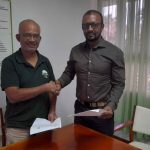
“I find it to be a beautiful project and a sign of progress within the village. The communities of Brownsweg, as well as the villages along the river, can benefit from this. We can improve our agricultural techniques to produce more and better crops,” says Basya Emelina Pobosi from Djankakondre in Brownsweg regarding the opening of the first Agroforestry Farmers’ Field School in Suriname, which is being established there. “We women also want to work together to achieve more from our agricultural activities. Through training, we can learn how to do that better,” adds Pobosi, who is also a farmer.
“We women also want to work together to achieve more from our agricultural activities.”
Knowledge transfer
This groundbreaking project, an initiative of Tropenbos Suriname and financed by TotalEnergies, was officially opened last Thursday during a meeting in the village’s krutu oso. The possibilities were discussed in a relaxed atmosphere with people smiling broadly, shaking hands and patting shoulders. The school will strengthen the knowledge and skills of the community, enabling them to ensure food security not only for their families, but also for their wider community. The first training courses are expected to start within three weeks and six months after that the first group of participants should have completed the training. The idea is also that participants who follow such a training will teach villagers (and possibly people in the broader environment) about agroforestry.
In the Brownsweg area, about a hundred people work in agriculture, mainly women. They grow Chinese tayer, ginger, bananas and various types of vegetables. A large part of the harvest is sold to gold seekers, for example. Shifting agriculture is one of the most important forms of land use and the second largest cause of forest degradation in Suriname, after gold mining. The integration of agroforestry techniques with local agricultural practices offers opportunities to combine traditional knowledge and science, reduce the degradation of the surrounding forest ecosystem and promote biodiversity. Thanks to the school, farmers can improve their techniques.
Sales
“It is the first time that people in the interior can follow agricultural training close to home,” says project coordinator Ivan Karnadi of Tropenbos Suriname. “I saw a similar school in French Guiana and wondered why we couldn’t realize something like this in Suriname. This idea had been in our organization for some time. Together we developed a plan, and now that idea is becoming reality. This is a milestone. I have been working at Tropenbos Suriname for fifteen years and am convinced that this project will have a major impact on the communities here.”
According to Karnadi, Tropenbos Suriname started in 2010 to raise awareness among the population to plant on higher ground.
“With agroforestry you can increase soil moisture. The school’s curriculum was developed together with a former employee of the Ministry of Agriculture, Livestock and Fisheries. Climate-resilient cultivation must be ensured, because the drastic weather changes in recent years pose major challenges with such as drought, which means that crops hardly grow.” Climate change is one of the biggest challenges, especially in the field of water management. Crops die during droughts, while heavy rainfall requires better water management.
In response to Pobosi’s request for attention to better sales opportunities, Klarnadi says: “We are also thinking about sales opportunities so that people can sell their products. We also want to think with the villagers about how they can get loans to finance their businesses. Tropenbos Suriname is open to collaboration with others to further develop the school.”
Goals
Construction of the school started in September and was scheduled to be completed earlier, but work was delayed due to weather conditions. The organization aims to complete the building in December. The objectives of this project are: To establish and maintain a permanent agroforestry garden that will serve as a training facility and demonstration of the agroforestry system. Supporting farmers and implementing a training program focused on good agricultural practices and agroforestry. Carrying out maintenance activities to ensure the sustainability of the project. Documenting and reporting key project activities.
Tropenbos Suriname is a knowledge-based, non-governmental organization committed to sustainable forest management and conservation. The organization focuses on knowledge development, capacity strengthening and organizational strengthening. As a knowledge broker, Tropenbos Suriname translates necessary information into actions and policies, with the aim of improving landscape management, governance, trade and financial practices. The organization has been planning and now implementing this groundbreaking project for some time now.-.