
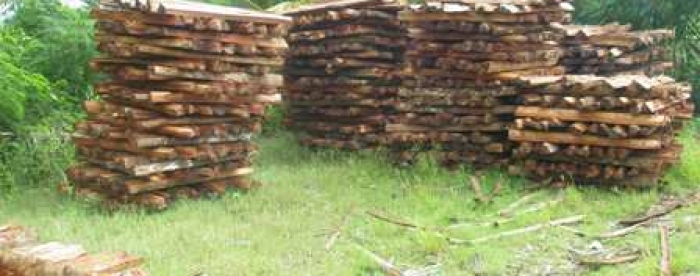
Based on its National Forest Policy (2005) the Government of Suriname (GoS) aims to improve the contribution of forests to the socio-economic development of the country. As part of this, the Foundation for Forest Management and Production Control (SBB) wishes to gain insight in and knowledge on the economics of Minor Timber Products (MTP), which until present, have their role in part neglected as a potential forest financing mechanism (FFM).
The production of timber is recognized as being the main income generating commodity from Suriname’s forests (Bhairo et al., 2009). Present production levels, however, are too small to sustain the national forest sector and its administration. MTPs, if effectively channeled into the formal economy, will contribute to a more sustainable national forest based economy.
This research resulted in improved knowledge on the socio-economic potentials of MTP’s. As such, next to the GoS, affected stakeholders are actors within all segments of the MTP product chain: producers, salesmen, retailers and consumers. In this stage of research, actors in the MTP product chain were mainly sources of information. The production of MTP’s is considered an (informal) income generating activity that requires only little capital investment and generates short-term revenues. Effective regulation of production, trade and retail of the MTP’s may directly contribute to sustainable income generation of the rural- and forest dependent people.
Duration
2009 – 2010
Objective
The objective of the project was to collect and analyse data on MTP’s, to enhance knowledge at the national level about the potential of MTP’s as a FFM, and to provide input for a national debate on the topic. The specific objective was: To collect, to analyse and to present data on the economics of minor timber products (MTP) from 2000 till 2010 and its potential as a national forest financing mechanism (FFM).
Related resourcesShow all
Partners
Visited 1 times, 1 visit(s) today